.png)
.jpg)
By: Michelle Edelman | CEO & Chief Strategy Officer
You’ve seen the ad. A family of two to four people. They’re happy. They’re laughing. Standing on white sand with a blue-green surf and sky rising in the background.
I’ve seen this ad, too. I’ve seen it for 20 years for countless destinations.
I’m so sick of seeing this work.
It’s everything that’s wrong with the way we tell travel stories. If every beach is the best beach, then why do they all look interchangeable?
Each of them makes the same mistake, and it’s a simple one. They’re highlight reels of all the great stuff that you can do at their destination. Showing things to do is logical, but if there are 1,000 different beaches in the US, the highlights will just be generic beach blur.
The travel brands catching our attention, and influencing our point of view, are doing something different. They’re trying to capture the unique way the brand feels. They go a layer deeper to understand the emotional space that ONLY that brand can own.
Think about the last great trip you took. The joy of it didn't arrive in a single spike while you were there. You felt it weeks before you left, scrolling through photos and reading reviews. You felt it in the airport, already narrating the story in your head. And you kept feeling it long after you returned, in the photos you shared and the stories you told.
PETERMAYER's Brand Joy Lab tracked this arc across more than 3,000 Americans, mapping emotional response across every phase of the vacation journey. The shape of it tells you something the travel industry has largely ignored.
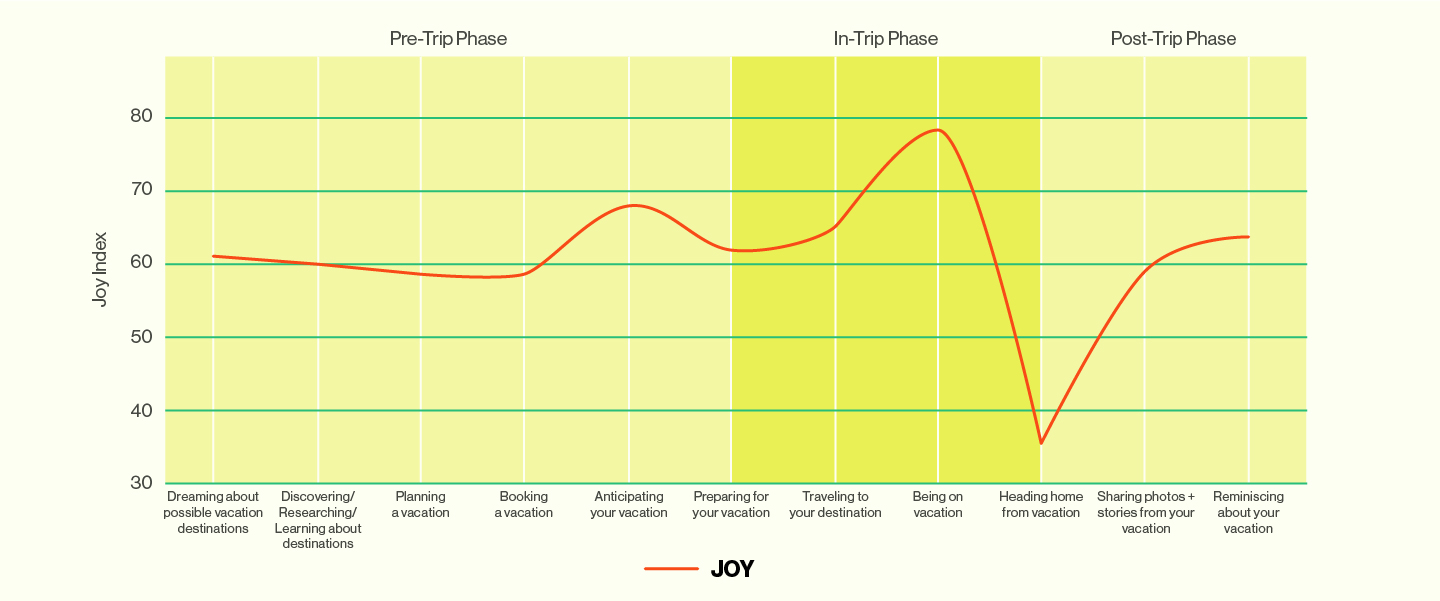
The anticipation phase carries real emotional weight. A third of travelers hit their highest possible joy score just thinking about an upcoming trip. That window, from dreaming through preparing to leave, sits largely unclaimed by travel marketers focused on the in-moment experience.
And the return home? Nearly one in five travelers registers a negative emotional response on the way home. It's the definitive low point of the entire journey, by a wide margin.
But the data shows something else. Joy rebounds. Reminiscing and sharing photos of a trip registers nearly as high as anticipating it. The end of the experience, it turns out, is not the end of the story.
Three brands have figured out how to write what comes next.
Disney Cruises dropped this 90-second piece of cinema in the middle of the Oscars this March.
The spot is a study in restrained storytelling. Its focus lies not in the features of the ship or the fun-and-sun ports of call that it visits. Instead, we watch a unique tradition develop between a father and son that spans decades.
It’s a story about family and love and time. And not so subtly, it’s about the role Disney plays as the creative force that brings generations together time and again. That’s a story that ONLY they can tell.
The payoff for the brand is loyalty, repeat visits, and generational love.
Last year, Marriott Bonvoy got away with showing their product as little as possible. You see the trappings of hotel dining and amenities pop up a few times in its anthem spot “You Are the Greatest Souvenir,” but lodging is not the focus here.
The storytelling pivots to what the experience of a great hotel unlocks, like a new tattoo, a delicious bite of dumpling, or even a romantic fling. By letting the memory of the experience be the star of the story, Marriott positions themselves as the stage setter.
It’s a strong emotional territory that few hospitality brands embrace. Making the hotel the jumping-off point for a lifetime of stories not only separates them from their category. It prepares the customer to think of all the future bookings they’ll make with the brand.
You don’t need a globally recognized brand or billion-dollar media budget to tell these stories.
We found the Petoskey Area’s emotional truth by listening. Over and over, we heard the same thing. The place has a singular beauty that you can feel.
Every competitor positioned their destination as an escape. They showed everything you could do while you were there. Our story centered on how you feel when you leave the Petoskey Area. Like you’ve been renewed. Your inner compass reset to its natural point.
We tried our best to channel this feeling. This is very restrained work, letting the beauty seep in, and adding just a hint of the magic that you feel when you’re there.
None of these campaigns abandon the emotional highpoint of travel. All three stories follow people actively on vacation. But each considers how a traveler is going to feel afterwards. Each wants to make going home feel a little sweeter in a way that only they can own.
Because the end of the trip is not the end of the journey. The Brand Joy Lab shows that our feelings of joy rebound as we reminisce and share photos of our trips.
When you tell a story that resonates across the experience, your past visitor isn’t just thinking about a great time they had.
They’re plotting their return.
Learn more about PETERMAYER’s background in travel and tourism.
Got the Receipts? Americans Seek Control in the Grocery Aisle as Affordability Slips.
A Brand Joy Lab study: 53% of Americans are more stressed about grocery prices, and the joy of catching a deal now outscores the meal it pays for.
Got the Receipts? Americans Seek Control in the Grocery Aisle as Affordability Slips.
A Brand Joy Lab study: 53% of Americans are more stressed about grocery prices, and the joy of catching a deal now outscores the meal it pays for.
Trial by Sleep: Hotels Still Rule the Overnight Stay. But There's Room for Disruption.
A Brand Joy Lab study finds parity in the joy people get from their accommodations — as long as they've tried them first.
Trial by Sleep: Hotels Still Rule the Overnight Stay. But There's Room for Disruption.
A Brand Joy Lab study finds parity in the joy people get from their accommodations — as long as they've tried them first.
The Missing Treat: Americans Love to Treat Themselves. But the Food Industry Is Missing a Big Reason Why.
The treat moment delivers nearly the same joy across incomes, but the category's creative only invites some people to the table. A Brand Joy Lab study.
The Missing Treat: Americans Love to Treat Themselves. But the Food Industry Is Missing a Big Reason Why.
The treat moment delivers nearly the same joy across incomes, but the category's creative only invites some people to the table. A Brand Joy Lab study.


